Understand everyday treatment
Around 1,000 people aged 70 or older will be followed during their usual radiotherapy or chemoradiotherapy. The study does not prescribe a specific treatment.
The SENIOR-2 study follows older adults with head and neck cancer. Together, we aim to better understand how treatment can reflect their individual needs.
How does radiotherapy affect older adults? Who may benefit from accompanying chemotherapy? And what matters most to patients themselves? SENIOR-2 explores these questions.
Quality of life, personal goals and treatment outcomes belong together.
For clinicians & researchersAround 1,000 people aged 70 or older will be followed during their usual radiotherapy or chemoradiotherapy. The study does not prescribe a specific treatment.
Questionnaires capture quality of life, personal treatment goals and burdens. Experiences after treatment are also considered.
Medical, functional, psychosocial and health-economic data will help build the evidence base for more individualised treatment decisions. The study will also investigate the role of geriatric screening. In addition, it will analyse which patients benefit from accompanying systemic therapy.
SENIOR-2 is an observational study. Your treatment follows the usual clinical practice at your treating centre.
Speak to your treating team or contact the study leadership to find out about participating centres.
The study is intended for people aged 70 or older with specified head and neck cancers. The study team checks eligibility and provides information before written consent.
Treatment information and your questionnaire responses are collected during routine treatment and follow-up.
People aged 70 or older with squamous cell carcinoma of the oral cavity, oropharynx, hypopharynx or larynx who meet the specified treatment-related criteria. The study team checks all inclusion and exclusion criteria.
The study does not prescribe study-specific therapeutic interventions. Treatment follows the usual clinical practice of the participating centre.
The study-related procedures consist of patient questionnaires, for example on quality of life and personal treatment goals. Your study team will explain the detailed schedule.
Recruitment is planned over 24 months, with five years of follow-up for the last participant enrolled. The total planned study duration is seven years.
Enrolment takes place through a participating study centre. This website does not collect patient or health data. Please do not send medical records via the general contact links.
For questions about your own treatment, please contact your treating team.
SENIOR-2 connects 37 study centres across Germany. Leipzig has already been initiated; further centres will follow step by step.
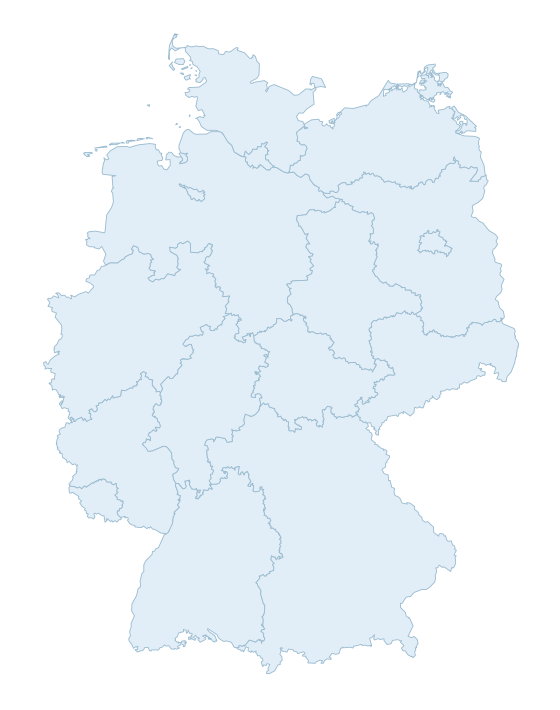
Hover over a point or tap it to see the hospital, department and address, with a direct link to the clinic website.
Green markers identify centres that have already been initiated. Participation is possible only after the respective centre has been initiated. Please contact study leadership for the current status.
Contact study leadershipMap data: BKG / geoBoundaries (dl-de/by-2-0, geometry simplified). City positions: GeoNames (CC BY 4.0).
Klinik für Radioonkologie und Strahlentherapie
Pauwelsstraße 30 · 52074 AachenVisit clinic websiteKlinik für Strahlentherapie
Stenglinstraße 2 · 86156 AugsburgVisit clinic websiteKlinik für Radioonkologie und Strahlentherapie
Campus Charité Mitte · Charitéplatz 1 · 10117 BerlinVisit clinic websiteUniversitätsklinik für Strahlentherapie und Radioonkologie
Teutoburger Straße 50 · 33604 BielefeldVisit clinic websiteKlinik für Strahlentherapie und Radio-Onkologie
Hölkeskampring 40 · 44625 HerneVisit clinic websiteKlinik für Strahlentherapie und Radio-Onkologie
Venusberg-Campus 1, Gebäude 55 · 53127 BonnVisit clinic websiteKlinik und Poliklinik für Strahlentherapie und Radioonkologie
Fetscherstraße 74 · 01307 DresdenVisit clinic websiteKlinik für Strahlentherapie und Radioonkologie
Moorenstraße 5 · 40225 DüsseldorfVisit clinic websiteStrahlenklinik
Universitätsstraße 27 · 91054 ErlangenVisit clinic websiteKlinik für Strahlentherapie und Onkologie
Theodor-Stern-Kai 7 · 60590 Frankfurt am MainVisit clinic websiteKlinik für Strahlenheilkunde
Robert-Koch-Straße 3 · 79106 FreiburgVisit clinic websiteInstitut für Radioonkologie – Strahlentherapie
Pacelliallee 4 · 36043 FuldaVisit clinic websiteKlinik für Strahlentherapie und Radioonkologie
Robert-Koch-Straße 40 · 37075 GöttingenVisit clinic websiteUniversitätsklinik und Poliklinik für Strahlentherapie
Ernst-Grube-Straße 40 · 06120 Halle (Saale)Visit clinic websiteKlinik für Strahlentherapie und Radioonkologie
Haus O26 · Martinistraße 52 · 20246 HamburgVisit clinic websiteKlinik für Strahlentherapie und Spezielle Onkologie
OE 8240 · Carl-Neuberg-Straße 1 · 30625 HannoverVisit clinic websiteKlinik für Strahlentherapie und Radioonkologie
Gebäude 6.5 · 66421 HomburgVisit clinic websiteKlinik für Strahlentherapie und Radioonkologie
Am Klinikum 1, Gebäude A5 · 07747 JenaVisit clinic websiteKlinik für Strahlentherapie
Hellmut-Hartert-Straße 1 · 67655 KaiserslauternVisit clinic websiteCampus Kiel · Klinik für Strahlentherapie
Arnold-Heller-Straße 3 · 24105 KielVisit clinic websiteKlinik und Poliklinik für Radioonkologie, Cyberknife- und Strahlentherapie
Gebäude 3/3a · Kerpener Straße 62 · 50937 KölnVisit clinic websiteKlinik und Poliklinik für Strahlentherapie
Stephanstraße 9a, Haus 5.2 · 04103 LeipzigVisit clinic websiteUniversitätsklinik für Strahlentherapie
Leipziger Straße 44 · 39120 MagdeburgVisit clinic websiteKlinik und Poliklinik für Radioonkologie und Strahlentherapie
Langenbeckstraße 1 · 55131 MainzVisit clinic websiteKlinik für Strahlentherapie und Radioonkologie
Theodor-Kutzer-Ufer 1–3 · 68167 MannheimVisit clinic websiteStandort Marburg · Klinik für Radioonkologie und Partikeltherapiezentrum (MIT)
Baldingerstraße · 35043 MarburgVisit clinic websiteKlinik und Poliklinik für Strahlentherapie und Radioonkologie
Campus Großhadern · Marchioninistraße 15 · 81377 MünchenVisit clinic websiteKlinik und Poliklinik für Radioonkologie und Strahlentherapie
Ismaninger Straße 22 · 81675 MünchenVisit clinic websiteKlinik und Poliklinik für Strahlentherapie
Albert-Schweitzer-Campus 1, Gebäude A1 · 48149 MünsterVisit clinic websiteKlinik für Radioonkologie und Strahlentherapie
Charlottenstraße 72 · 14467 PotsdamVisit clinic websiteKlinik und Poliklinik für Strahlentherapie und Radioonkologie
Franz-Josef-Strauß-Allee 11 · 93053 RegensburgVisit clinic websiteKlinik und Poliklinik für Strahlentherapie
Südring 75 · 18059 RostockVisit clinic websiteKlinik für Strahlentherapie
Wismarsche Straße 393–397 · 19055 SchwerinVisit clinic websiteRadio-Onkologie und Strahlentherapie
Feldstraße 16 · 54290 TrierVisit clinic websiteUniversitätsklinik für Radioonkologie
Hoppe-Seyler-Straße 3 · 72076 TübingenVisit clinic websiteKlinik für Strahlentherapie und Radioonkologie
Albert-Einstein-Allee 23 · 89081 UlmVisit clinic websiteKlinik und Poliklinik für Strahlentherapie und Radioonkologie
Studienambulanz Haus B3 · Josef-Schneider-Straße 11 · 97080 WürzburgVisit clinic websiteAn interdisciplinary team at Leipzig University Hospital coordinates the study. A scientific advisory board with patient representation contributes additional perspectives.
Principal investigator
Managing senior physician and Advanced Clinician Scientist (LeiCoT programme)
Department of Radiation Oncology

Deputy principal investigator
Director
Department of Radiation Oncology, Leipzig University Hospital
Dr Josephine Beier · Dr Maria Eschke · PD Dr Ina Patties
ZKS Leipzig: Dr Anett Schmiedeknecht (project management), Dr Oana Brosteanu (managing director), Dr Miroslav Bacak (biometrics), Kathrin Scheibe (data management), Marc Viehweg
Health economics: Jun.-Prof. Dr Dennis Häckl
Medical psychology: Prof. Dr Anja Mehnert-Theuerkauf
Radiation oncology study office: PD Dr Clemens Seidel (medical lead), Nadja Talhi (lead study coordinator)
Funded by German Cancer Aid. Officially supported by the German Society for Radiation Oncology (DEGRO). Project management, data management and biometrics: ZKS Leipzig.
Here we share updates on the study launch, participating centres and recruitment progress.
On 8 October 2026, the first patient was enrolled in SENIOR-2 in Leipzig. Further study centres will be initiated step by step.
* For the last participant enrolled.
SENIOR-2 has begun: the first patient was enrolled at Leipzig University Hospital on 8 October. Further centres will be initiated over the coming weeks.
The prospective observational study is planned to launch from October 2026 at more than 35 centres. The planned sample size is 1,000 participants.
German Cancer Aid funds SENIOR-2 with approximately €715,000. The focus is on strengthening the evidence base for care of older adults with head and neck cancer.
SENIOR-2 continues the work of the SENIOR consortium as a prospective, multicentre cohort study. These publications represent previous work by the consortium.
View study registrationMarschner SN et al. · JAMA Otolaryngology–Head & Neck Surgery · 2026;152:36–46 · DOI: 10.1001/jamaoto.2025.3840 ↗
Rühle A et al. · Radiotherapy and Oncology · 2025;204:110697 · DOI: 10.1016/j.radonc.2024.110697 ↗
Rühle A et al. · International Journal of Radiation Oncology, Biology, Physics · 2024;118:1282–1293 · DOI: 10.1016/j.ijrobp.2023.10.025 ↗
Rühle A et al. · JAMA Network Open · 2023;6:e230090 · DOI: 10.1001/jamanetworkopen.2023.0090 ↗
Whether you are interested in taking part, have questions about the study or would like to discuss research: please get in touch.
Please do not send health data or medical records to the general contact address.